
How AI is Changing the Platform and Creator Relationship
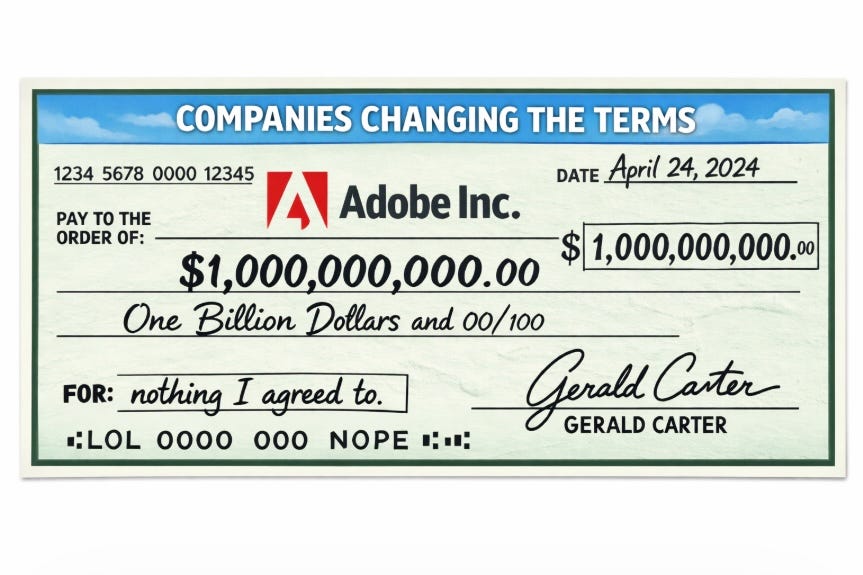
The “Blank Check”: What Adobe’s Contract Argument Really Means for Every Creator.

I’ve been in a legal battle since 2023 fighting for creators rights and really want to help people understand what Adobe is actually arguing here, because it affects every single person who has ever uploaded content to any platform.
Not just photographers. Not just Adobe Stock contributors. Everyone. If you’ve ever uploaded a photo, a video, a voice recording, a design, a document — to any platform that has a terms of service — what I’m about to explain could apply to you.
What the Contract Actually Said
The contract I signed gave Adobe a license to use my images for “developing new features and services [to promote my work].” The full context of the agreement made it clear what that meant. The sections were literally labeled “License We Need to Distribute Your Work to Our End Users” and “License We Need to Promote Your Work.”
That language was there so Adobe could do normal business things. Improve the platform. Create better search functionality. Develop new tools for the stock photo marketplace. Standard stuff that you’d expect a technology company to do with a content library it’s distributing on your behalf.
There was no section called “License We Need to Use Your Work to Train Our AI Models for Free and Cut You Out of Any Resulting Revenue.” Because that was never the deal. The deal was a revenue share. I provide content. Adobe distributes it to end users. We both make money. That was the overarching benefit of the bargain for both parties.
What Adobe Is Actually Arguing
Adobe’s argument? The word “new” means they can do anything new. Anything. Including something that didn’t exist when I signed the contract. Including AI training. Including building a tool that directly competes with the very content I licensed to them.
Think about that logic for a second.
Because the word “new” is in the contract, any new thing Adobe decides to do with your content is supposedly covered. It doesn’t matter that AI training wasn’t mentioned. It doesn’t matter that generative AI didn’t exist as a commercial product when I signed. It doesn’t matter that the purpose of the license was clearly about distribution and promotion. The word “new” apparently overrides all of that context.
Five years from now, if they want to use your images to train humanoid robots that look like you? New feature. If they want to beam your photos onto billboards from satellites? New service. If they want to sell your content directly to your competitors without compensation? New offering.
The word “new” became a blank check.
Why This Isn’t Just My Problem
Here’s where this gets bigger than Adobe and bigger than me.
Every creator who has a similar clause in their agreement — and most do, because these are standard, non-negotiable, click-through contracts — should be very concerned.
Go look at the terms of service for whatever platform you upload content to. Look for language like “new features,” “new services,” “new products,” “improve our offerings.” You’ll find something like it. Almost every platform has some version of this clause because it’s meant to give them operational flexibility. And that’s fine when it’s being used for what it was intended for.
But the moment a company argues that “new features” includes training generative AI models on your work — models that then compete with you, replace the need for your content, and generate revenue you’ll never see — that operational flexibility becomes something else entirely. It becomes a blank check written against your creative output for any future technology that hasn’t been invented yet.
And you’ve already signed it.
You Didn’t Negotiate This. Nobody Did.
One thing I want to help people to understand about these contracts: you don’t get to negotiate them. I didn’t sit in a room with Adobe’s lawyers and agree to specific terms. I clicked a button. The same button every contributor clicks. The same kind of button you click when you sign up for any platform.
These are contracts of adhesion — take it or leave it. The platform writes the terms. You either accept them as-is or you don’t use the platform. There’s no counteroffer. There’s no red-lining. There’s no conversation.
And now those same non-negotiable terms are being used to justify using your creative work for AI training — something that didn’t exist when the terms were written. The creators who signed those agreements never could have imagined this use. And the platforms know it.
That’s the part that gets me. It’s not like Adobe came to contributors and said “hey, we want to use your images for AI training, are you in?” That would have been the honest approach. That would have been the most sound legal strategy. Instead, they kept it vague, relied on broad language, and then argued after the fact that the language covered it all along.
They didn’t ask because they knew what the answer would be.
Why We’re Fighting to Vacate This Ruling
That’s why we’re fighting to have this ruling vacated. Not just for Diversity Photos, but because if this interpretation stands, it sets a precedent that guts creator rights across the board.
No contract from the pre-AI era should be interpreted as a blank check for AI training. If a company wants to use your content for AI, they should have to say so explicitly. They should have to get your informed consent. And they should have to compensate you. That’s not radical. That’s basic contract law — both parties should understand what they’re agreeing to.
This is not over. We’re in court now on the petition to vacate. And regardless of what happens with my specific case, I want every creator to understand the principle at stake: the word “new” in your contract should not mean unlimited.
What You Can Do Right Now
Go read the terms of service for every platform where you upload creative work. Search for “new features,” “new services,” “improve,” “develop.” See what language they’re using and think about what a company could argue that language covers if they decided to train AI on your content tomorrow.
If the platform has an arbitration clause, check if there’s an opt-out window. Most give you 30 days from when you sign up or from when the terms were last updated. That’s your window. Don’t miss it.
And talk about this. Share this post. The more creators who understand what’s happening, the harder it becomes for companies to use vague language as a blank check. They rely on people not reading the terms. They rely on people not understanding the implications. That advantage disappears when people start paying attention.
The word “new” should mean innovation. It should mean better tools, better experiences, better platforms for creators. It should not mean unlimited access to your life’s work for any purpose a corporation can imagine.
That’s not what any of us agreed to. And that’s why this fight matters.